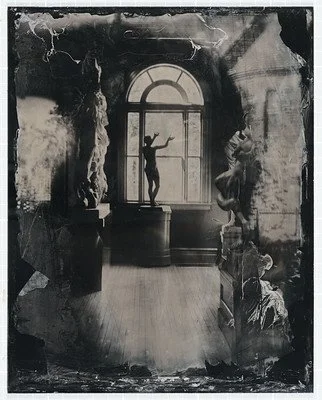
8”x10” Wet plate collodion - Ambrotype - Springfield Quadrangle
The Seat of the Muses: An Edited Conversation
For more than three decades, The Seat of the Muses has explored museum collections, artifacts, casts, specimens, architecture, and the lives of objects. In 2026, James Gehrt began incorporating wet plate collodion into the project. The following edited conversation grew out of months of reflection on that process and the questions that emerged from it.
Why did wet plate collodion become the next question worth pursuing?
It was less a question than an itch. The interest had been building for years through teaching photographic archives, collecting nineteenth-century photographs, and studying wet plate photographers. Part of it was experiential. I often talk about photography as involving four participants: the photographer, the subject, the viewer, and the historian. I wanted to understand the process from the photographer's perspective. When I looked at ambrotypes and wet plate negatives, I wanted to know what it felt like to make them. How much attention did the chemistry require? How did photographers manage the process? How did the technical demands influence the images they produced? For a long time, the process seemed almost beyond reach. I was not interested in traveling with a portable darkroom or making portraits. The breakthrough came when I realized I could adapt collodion to the way I already worked. The desire was not to recreate the nineteenth century. It was to understand the process from the inside.
Before you made your first successful plate, what did you think the process would be like?
I expected the process to be messy, and I was right. What surprised me was how sensitive it was. Small changes in time, temperature, and movement can have a noticeable effect on the result. The process requires a level of physical precision that I had never encountered before. I was also surprised by the beauty of the finished object. The glass itself has a presence. Highlights glow. Bright areas bloom. Silver gelatin printing eventually became predictable for me. Wet plate collodion still contains an element of discovery. Sometimes something unexpected happens and my first reaction is curiosity. How did that happen? Can I do it again?
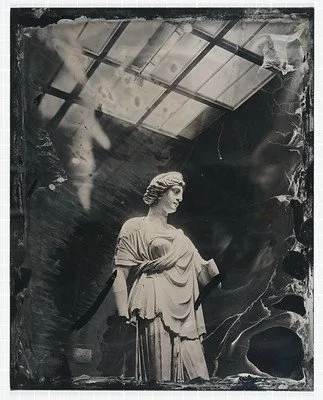
8”x10” Wet plate collodion - Ambrotype - Boston MFA
At what point did the plates stop being experiments and become photographs?
For me, they never stopped being experiments. I still think of them as experiments because I am still learning and asking questions. At the same time, they have always been photographs. I do not separate experimentation from photography. The photograph exists as an idea, a perception, something I see and want to express. Collodion gives me another voice for that expression. The experimentation continues, and the photographs emerge through that process.
What has collodion revealed about museum objects that earlier approaches did not?
At first, the connection seemed simple. Many of the objects I photograph could have existed during the wet plate era. There was an interesting play with time. As I continued working, the process revealed something deeper. A long-standing theme within The Seat of the Muses has been an interest in the lives of objects. Museum artifacts, casts, specimens, and collections all have histories that extend far beyond the moment they are photographed. An ambrotype feels different to me than a print. The photograph is no longer simply a representation of the object. It becomes another object. I sometimes think of it as a split in the timeline of the original artifact. The original object continues to exist, but another object has emerged from it and now carries part of that story forward.
As an archivist, what is it like to make objects that may out live you?
It is a somewhat sad question because I have spent much of my life seeing what actually happens to photographs. Most photographs are not carefully preserved. They end up in basements, attics, flea markets, antique stores, and junk shops. Some are rescued. Most simply become detached from the people who made them. Because of that, I have become realistic about the future of my own work. I do not know who, if anyone, will care about these photographs one hundred years from now. What I can do is make the work honestly and preserve it responsibly. Beyond that, the future belongs to another generation. The reason I make photographs is not because I know what will happen to them. I make them because I feel compelled to make them now.
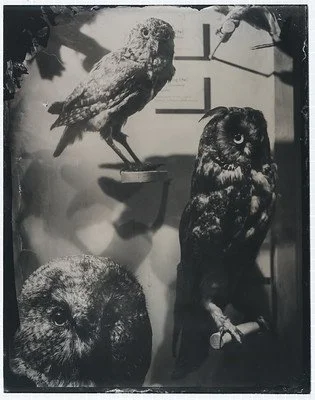
11”x14” Wet plate collodion - Ambrotype - Harvard Museum of Naturual History
Has working with historical photographs changed how you think about your own place in that timeline?
Not directly. For me, there are two related interests. One is an interest in photography as a medium and subject of study. The other is an interest in being a photographer. What interests me most is not photography itself. It is seeing. I often say that I was a photographer before I knew what photography was. Photography became the tool that allowed me to engage with the visual world. Historical photographs have certainly influenced me, but the primary motivation remains the same. It is about paying attention and finding a way to respond to what I see.
What are you trying to see in The Seat of the Muses that you have not fully seen yet?
I did not begin The Seat of the Muses with the intention of documenting museums. Museums are places I enjoy visiting. Since I almost always have a camera with me, photographing them became a natural extension of being there. I photograph what interests me, and only later do patterns begin to emerge. I may notice that I have photographed stairways repeatedly, or fountains, or displaycases, or shadows. Meaning often arrives after the photographs exist. That is why I hesitate when asked what I have not fully seen yet. If I already knew what it was, I probably would not need the photographs. Part of the value of photography is its ability to reveal things I was not aware I was looking for.
When you are standing in a museum, what causes you to lift the camera?
Part of it is light. Light changes everything. Sometimes it is the way light reveals form or transforms an ordinary scene. Part of it is the object itself. It may be humor, sadness, a strange juxtaposition, or something slightly surreal. Over time, I have come to believe that many of the things I photograph are a kind of self-portrait. I often feel a sense of recognition. Looking at an Egyptian cat sculpture, I might think, 'If I were an Egyptian cat sculpture, that is the one I would be.' The camera comes to my eye when I sense a connection, even if I do not yet understand it.
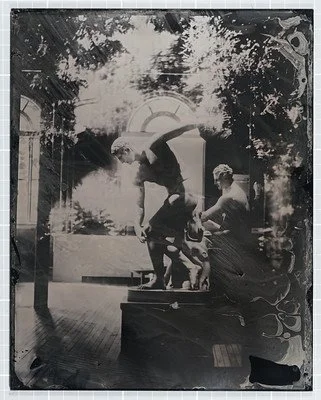
8”x10” Wet plate collodion - Ambrotype - Springfield Quadrangle
After four months of collodion, what question are you carrying into the darkroom now?
The questions have become more refined. In the beginning, most of the questions were technical. How do I eliminate defects? How do I avoid contamination? How do I solve adhesion problems? Those questions have not disappeared, but they are less dominant now. The newer questions are about shadow density, tonal relationships, backing materials, and refinement. Another set of questions is beginning to emerge. Which images work well in collodion and which do not? Why does one photograph gain something from the process while another loses something? How should the plates be arranged? How does the process influence meaning? There will always be questions. That is part of the attraction. The questions change over time. My hope is that the answers become more meaningful.
——
What emerged from these conversations was not simply a story about learning wet plate collodion. The deeper story concerns attention, curiosity, recognition, and the lives of objects. Collodion became important not because it recreated the nineteenth century, but because it transformed photographs into objects again. Throughout the discussion, one idea surfaced repeatedly. Meaning is rarely discovered in advance. It emerges through looking, revisiting, editing, and paying attention over time. Perhaps the simplest summary of the project is this: “I don't know what I haven't fully seen yet. I'll recognize it when I encounter it.”